
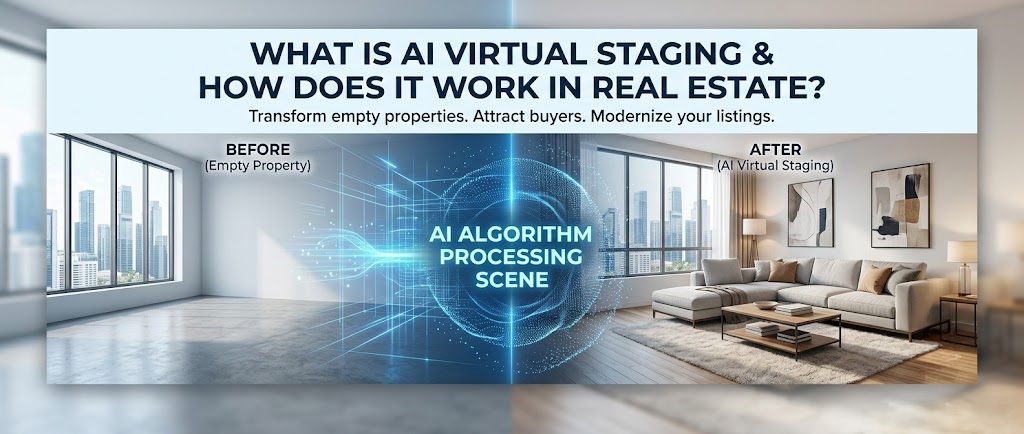
Marketing a vacant property presents a significant challenge for real estate professionals.
Empty rooms lack visual scale, often appearing smaller and less inviting in listing photographs.
Without physical context, potential buyers struggle to visualize how a space can be utilized, which directly impacts online engagement and time-on-market metrics.
The Strategic Solution: Generative AI is quietly transforming real estate visuals. AI virtual staging turns raw, empty property photos into emotionally compelling, buyer-ready images in seconds, replacing the need for expensive physical furniture rentals.
In this comprehensive analysis, we will examine the mechanics of generative AI in real estate, how the underlying technology operates, and the operational benefits for modern marketing strategies.
What is AI Virtual Staging?
Virtual staging is the process of digitally inserting furniture, decor, and design elements into a photograph of an empty room.
Historically, this required human graphic designers to manually composite 3D assets, resulting in turnaround times measured in days and higher per-image costs.
AI virtual staging completely automates this workflow using machine learning models to analyze the room and seamlessly render realistic furnishings.
The Economic Disruption of Property Staging
The financial disparity between physical and digital staging is substantial, reshaping how properties are brought to market.
Traditional physical staging typically requires a capital investment of $2,500 to $6,000 per listing, encompassing inventory rental, professional design fees, and logistical transportation.
In contrast, AI virtual staging operates at a near-zero marginal cost, typically ranging from $1 to $15 per image while delivering finalized assets in under a minute.
Key Takeaway: The rapid cost reduction allows brokers to professionally stage every listing in their portfolio, democratizing high-end visual marketing across all property price tiers.
How Does AI Virtual Staging Work? The Practical Workflow
Modern marketing platforms prioritize user convenience, eliminating the need for advanced graphic design software.
Agents, property owners, and photographers can execute the entire digital staging process from a standard web browser or mobile application.
The standard user workflow operates through four highly optimized steps:
| Phase | User Action | System Process |
|---|---|---|
| 1. Image Upload | Upload a high-quality JPG or PNG of the vacant or cluttered room. | Data Ingestion The platform analyzes the base file; advanced tools can declutter existing tenant furnishings first. |
| 2. Configuration | Select the specific room type and the desired interior aesthetic. | The user defines parameters, choosing from presets like modern, minimalist, luxury, or mid-century to target local demographics. |
| 3. AI Generation | Initiate the processing sequence and wait 15 to 60 seconds. | The generative model places accurately scaled furniture, rugs, and art while mapping local lighting and perspective. |
| 4. Export | Review the generated variants, adjust the layout if needed, and finalize. | The completed image is exported watermark-free, ready for immediate syndication to the MLS and digital ad campaigns. |
Key Takeaway: The streamlined interface allows for pre-listing visual production to be compressed from weeks into a 24-hour turnaround window.
Under the Hood: The Generative AI Technology
The core innovation is not simply pasting digital assets onto a background, but rather the system’s ability to interpret a 2D image as a 3D environment.
Modern platforms utilize a stacked pipeline of computer vision and diffusion modeling to achieve photorealism.
Scene Understanding and Object Segmentation
The model first maps the architectural geometry, identifying the precise boundaries of walls, ceilings, windows, and doorways.
By establishing accurate spatial depth and perspective lines, the system ensures that rendered objects do not appear distorted or disproportionate to the physical environment.
Furthermore, segmentation algorithms can isolate existing clutter or outdated furniture, digitally repainting the structural background before new assets are applied.
Generative Rendering and Style Transfer
Once the spatial framework is established, diffusion models synthesize the furniture and decor based on the user’s selected aesthetic.
The AI meticulously calculates environmental variables, matching the original photo’s ambient lighting, generating accurate cast shadows, and reflecting light off specific material textures.
Key Takeaway: Advanced generative rendering produces localized lighting and realistic textures, resulting in marketing images that are nearly indistinguishable from physically staged photography.
How AI Checks Furniture Fit and Spacing
A critical evolution in spatial technology is the transition from purely aesthetic rendering to precise, mathematical planning.
Modern AI room planners do not just make a space look appealing; they utilize real measurements and 1:1 augmented reality (AR) models to verify accurate spatial fit.
- True-to-Scale Floor Plans: Applications allow users to scan a room, generating a floor plan where structural elements are mapped strictly to real-world dimensions (meters, feet, or inches).
- Real Furniture Dimensions: Digital catalog items are stored with precise width, depth, and height data, ensuring they populate the layout at their exact physical scale.
- Automatic Scaling and Clearance: The AI automatically measures clearances for walkways and door openings, ensuring a piece fits comfortably in practical usage, not just mathematically.
- AR Room Preview: AR viewers project a 1:1 scale 3D model through a smartphone camera, allowing potential buyers to physically walk around the digital asset to check proportions prior to a transaction.
Key Takeaway: Real estate technology now empowers users to accurately verify that a 2-meter sofa perfectly aligns with a 1.8-meter wall before any capital is spent or heavy lifting occurs.
The Business Benefits and Market ROI
Deploying AI staging yields measurable improvements in buyer psychology and campaign performance.
For instance, a vacant luxury property in Los Angeles can be digitally furnished in multiple architectural styles simultaneously without requiring a single physical logistics contract.
According to the National Association of Realtors, approximately 81% of buyer agents report that staging actively helps clients visualize a property as a future home.
- Accelerated Sales Velocity: Staged properties historically generate higher online engagement, with industry data indicating they can sell up to 73% faster than unstaged alternatives.
- Risk Mitigation: Conducting staging entirely online eliminates the liability of physical damage to floors, walls, and fixtures during the moving process.
- Scalable Personalization: Brokers can instantly execute A/B testing on marketing channels by generating a minimalist layout for one demographic and a family-friendly aesthetic for another.
Key Takeaway: AI virtual staging maximizes marketing ROI by drastically reducing upfront costs while simultaneously increasing property visibility and buyer interest.
Navigating MLS Compliance and Disclosure
As generative visuals become increasingly photorealistic, industry regulatory bodies have established necessary guidelines to protect consumer transparency.
In the vast majority of jurisdictions, virtually staged photographs are fully permitted, provided the enhancements are explicitly disclosed.
The Core Compliance Rule: AI technology may be used to alter furnishings, but it must never be used to misrepresent the structural integrity or permanent fixtures of the home.
Most Multiple Listing Services dictate that agents apply a clear “Virtually Staged” text label or watermark directly on the optimized images.
Additionally, it is standard practice to include an unstaged, “as-is” photograph of the room within the listing gallery to ensure potential buyers have an accurate baseline representation.
Key Takeaway: Strict adherence to disclosure regulations ensures ethical marketing practices while still leveraging the powerful conversion benefits of digital staging.
Frequently Asked Questions
What is the difference between traditional virtual staging and AI virtual staging?
Traditional virtual staging relies on graphic designers to manually edit 3D assets into a photograph, which is time-intensive. AI virtual staging uses machine learning to automatically analyze room geometry and render properly scaled furnishings in under a minute.
Is AI virtual staging allowed on MLS platforms?
Yes, AI virtual staging is widely accepted across MLS platforms, provided the agent includes a clear disclosure (such as a watermark) and refrains from digitally altering the permanent structure, windows, or walls of the property.
How does AI virtual staging handle existing clutter?
Advanced AI staging platforms utilize object segmentation technology to identify and digitally remove existing furniture, tenant belongings, or clutter, effectively repainting the background before generating the new digital staging.
Elevate Your Listing Strategy
Generative AI fundamentally optimizes how real estate professionals market properties to prospective buyers.
- Optimize expenditure: Reduce staging costs by over 90% while maintaining premium visual quality.
- Accelerate timelines: Transition from raw property photos to fully staged marketing assets in seconds.
- Maximize engagement: Present compelling, lifestyle-driven visuals that capture immediate digital attention.
Continuing to market vacant properties is an unnecessary risk in a highly competitive digital landscape.
To access comprehensive templates and streamline your video marketing workflow, utilize the Real Estate Listing Power Pack, available for one hundred and fifty dollars, directly at OneVideoPro.

