

Generative Engine Optimization vs SEO: Winning the New Search Landscape
For the last two decades, digital visibility meant ranking in a list of ten blue links.
Today, AI search engines read the web and summarize it directly for the user.
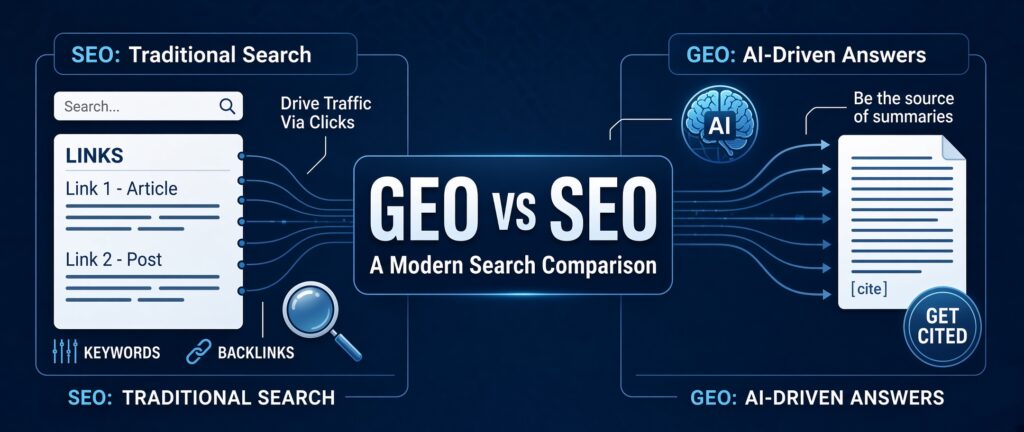
The Core Difference: SEO is about winning the click, but GEO is about being the source of the AI’s answer.
To survive this massive technological shift, content creators and brands must radically restructure how they write, format, and deliver information to their audiences.
What is SEO? (Search Engine Optimization)
SEO is the traditional practice of optimizing a website to rank highly on search engine result pages (SERPs) like classic Google or Bing.
The Model: A user searches a query, the engine retrieves the most relevant indexed pages, and the user clicks a link to find the answer themselves.
The Tactics: It relies heavily on matching keywords, building backlinks to prove authority, optimizing technical site speed, and structuring meta tags.
What is GEO? (Generative Engine Optimization)
GEO is the practice of optimizing content so it is ingested, understood, and cited by AI-driven search engines.
These dynamic new engines include Perplexity, ChatGPT Search, and Google’s AI Overviews.
The Model: A user asks a question, and the AI synthesizes an answer on the spot, citing the sources it used to build that response.
The Tactics: It prioritizes high information density, unique data, conversational context, and direct answers over keyword repetition.
The Core Differences: Generative Engine Optimization vs SEO
Understanding the fundamental differences between these two strategies is critical for preventing your digital traffic from plummeting.
| Feature | SEO Strategy | GEO Strategy |
|---|---|---|
| The Primary Goal | Drive traffic to your website via clicks. | Get cited as the authoritative source in an AI summary. |
| The Target Engine | Traditional Google Search, Bing. | Google AI Overviews, Perplexity, ChatGPT Search, Claude. |
| Content Strategy | Long-form articles, naturally repeating target keywords. | Punchy, highly structured text (lists, tables) with direct answers. |
| Authority Signals | Number and quality of external backlinks. | Original research, first-hand expertise, and brand mentions. |
| User Journey | Search → Scroll → Click → Read. | Ask → Read AI Summary → (Maybe) click citation for deep dive. |
How Your Content Needs to Change for AI Search
Whether you are structuring digital media, writing product descriptions for e-commerce, or scripting micro-learning content, the old rules are officially dead.
The outdated “SEO recipe” of burying the answer at the bottom of a 2,000-word article no longer works.
AI engines look for three foundational pillars:
1. Deliver Direct Answers First
AI models look for clear, definitive statements.
If a query is “What is the best RGB microphone for streaming?”, GEO requires you to explicitly state the answer in the first paragraph, followed by the reasoning.
2. Maximize Information Density
Cut the fluff immediately. AI ignores filler text.
Highly structured data—like bullet points, comparison tables, and clear headings—is much easier for a Large Language Model (LLM) to parse and cite.
3. Provide Strict Originality
AI can generate generic information infinitely.
To get cited, you need to provide what the AI doesn’t have: original statistics, firsthand testing, unique case studies, or distinct expert opinions.
Frequently Asked Questions
What engines rely on Generative Engine Optimization?
Platforms that synthesize answers on the spot rely heavily on GEO tactics. This includes industry leaders like Google AI Overviews, Perplexity, ChatGPT Search, and Claude.
How do I format my content for AI search engines?
AI models prefer high information density over long-form prose. You should utilize highly structured text, including bullet points, comparison tables, and clear headings to ensure your data is easily parsable.
Is keyword repetition still important for GEO?
No. While traditional SEO relies heavily on matching and repeating target keywords, GEO prioritizes unique data, conversational context, and direct answers.
Transition Your Strategy to GEO Today
The evolution from a list of blue links to synthesized AI answers is the biggest shift in digital visibility history.
- Target Citations over Clicks: Make your goal becoming the definitive source an AI wants to reference.
- Structure Your Data: Implement comparison tables, bullet points, and punchy text to drastically increase information density.
- Lead with the Solution: Provide direct answers immediately in your text, and save the deep-dive reasoning for later.
Audit your top-performing blog posts right now and restructure them using these core GEO principles to future-proof your traffic!
