
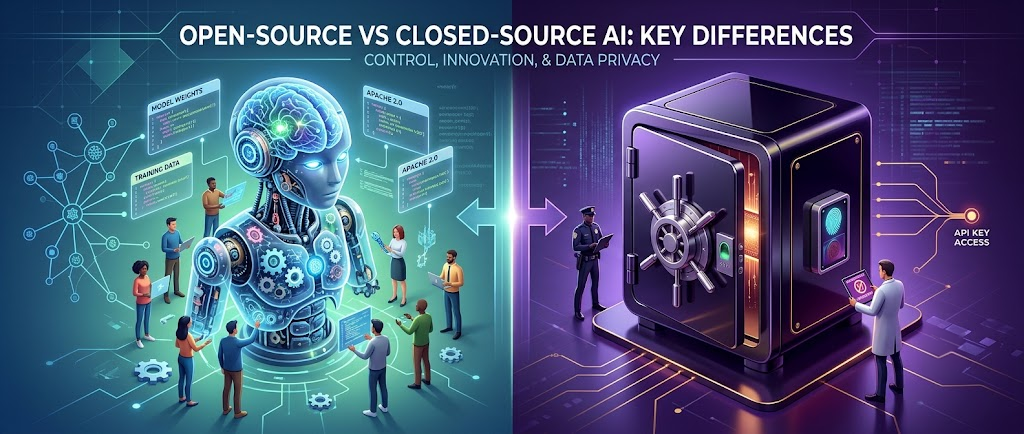

Open-Source vs Closed-Source AI: Which Is Best?
How do open-source and closed-source AI actually differ[cite: 1]? This is the biggest question technical leaders face today.
Choosing the wrong artificial intelligence infrastructure can lead to massive security risks or bloated monthly server costs.
The Core Solution: The choice comes down to control versus convenience. One system keeps code private behind paid APIs, while the other shares its entire blueprint publicly[cite: 1].
In this comprehensive guide, we will break down the true costs, security benefits, and operational requirements of both AI architectures.
What is Closed-Source AI?
When evaluating infrastructure, closed-source models offer unmatched plug-and-play convenience.
Closed AI is like ordering food delivery[cite: 1]. You do not need to worry about the underlying ingredients or the kitchen equipment.
Instead of building a massive internal network, the system runs entirely in the cloud[cite: 1].
The Cost of Convenience
Organizations can quickly bypass massive capital expenditures because you buy zero physical hardware[cite: 1].
Pricing is strictly based on your direct usage and API access levels.
You pay two dollars per million tokens, or a flat twenty dollars monthly[cite: 1].
Zero Maintenance Overhead
This streamlined approach drastically reduces the need for expensive in-house engineering talent.
Companies realize that you need zero technicians to manage it[cite: 1].
When updates drop, it upgrades instantly[cite: 1]. This keeps your business on the cutting edge without any manual labor.
What is Open-Source AI?
On the opposite end of the spectrum, open-source models prioritize absolute freedom and transparency.
Open source gives you the free recipe[cite: 1]. This means the foundational architecture is available for anyone to inspect.
Because you have the base blueprint, you can customize every line of code[cite: 1].
The Hidden Costs of Hosting
Developers are not restricted by corporate API rate limits or mysterious black-box algorithms.
However, this technical freedom comes with significant operational trade-offs for businesses.
Hosting demands heavy servers and technicians[cite: 1]. You must purchase dedicated GPUs and hire machine learning specialists.
Comparing the Two AI Models
To choose the right model, you must align your business needs with the strengths of the architecture.
Use the table below to quickly assess which AI deployment strategy fits your organization.
| Feature | Closed-Source AI | Open-Source AI |
|---|---|---|
| Code Visibility | Proprietary and hidden | 100% Publicly Available |
| Infrastructure | Runs in the cloud[cite: 1] | Hosted on local servers |
| Hardware Required | Zero physical hardware[cite: 1] | Heavy servers[cite: 1] |
| Maintenance | Zero technicians needed[cite: 1] | Requires skilled engineers |
Who Uses Which AI Strategy?
Different industries have vastly different requirements when it comes to artificial intelligence integration.
Because of the low barrier to entry, everyday creators choose closed AI for simplicity[cite: 1].
Small businesses want immediate results without dealing with technical headaches or server crashes.
Why Highly Regulated Industries Choose Open-Source
However, highly regulated enterprises cannot afford to transmit proprietary client data through public cloud APIs.
Meanwhile, banks and hospitals prefer open source[cite: 1].
Data privacy regulations like HIPAA and strict financial compliance laws demand absolute data governance.
The Security Advantage: By building isolated, air-gapped environments, it keeps sensitive data on private local servers[cite: 1]. This strict control ensures that no information ever leaves their building[cite: 1].
The Rise of Hybrid AI Architectures
The tech industry is quickly realizing that companies do not have to limit themselves to just one extreme.
Today, forward-thinking enterprises blend both strategies[cite: 1].
By combining these technologies, they maximize creative output while maintaining ironclad data security.
- External Tasks: They use closed APIs for creative power[cite: 1]. This handles marketing, drafting, and generalized research.
- Internal Tasks: They run open models for secure operations[cite: 1]. This analyzes financial records and protected health information.
This balanced architecture represents the most logical path forward for corporate adoption.
Ultimately, that hybrid model powers the digital future[cite: 1].
Frequently Asked Questions
What is the main difference between open-source and closed-source AI?
The primary difference is accessibility. One system keeps code private behind paid APIs, while the open-source alternative shares its entire blueprint publicly for developers to modify[cite: 1].
Is open-source AI completely free to use?
While open source gives you the free recipe to the underlying code[cite: 1], deploying it is not entirely free. Running these complex models demands heavy servers and skilled technicians, which can be costly[cite: 1].
Why do hospitals use open-source AI?
Banks and hospitals prefer open source because it allows them to maintain strict data compliance[cite: 1]. It keeps sensitive data on private local servers so no information ever leaves their building[cite: 1].
Final Thoughts on Choosing Your AI Model
Choosing between open-source and closed-source AI comes down to evaluating your team’s technical capacity and security needs:
- Choose Closed-Source if: You want instant upgrades[cite: 1], zero physical hardware[cite: 1], and a flat monthly cost[cite: 1].
- Choose Open-Source if: You require private local servers[cite: 1] and the ability to customize every line of code[cite: 1].
- Choose Hybrid if: You want to blend both strategies to balance creative power with secure operations[cite: 1].
Ready to optimize your tech stack? Evaluate your company’s data privacy needs today and deploy the model that fits your secure digital future!
