
Why Video is the New Business Card
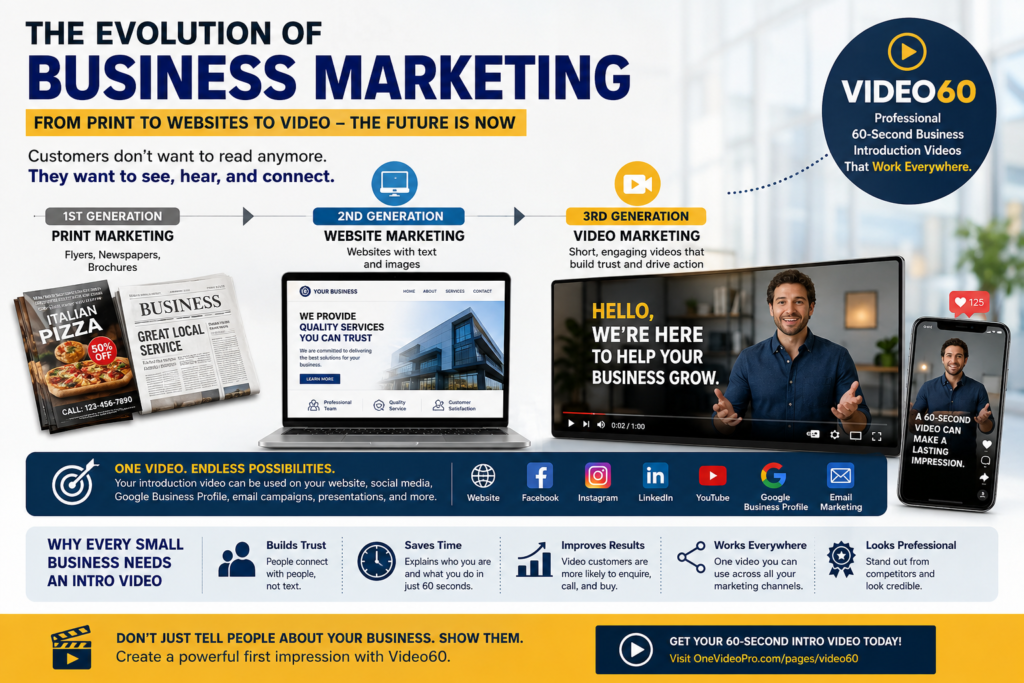
Discover how business marketing evolved from print flyers to dynamic video. Boost conversion rates and engage buyers faster with short business videos

The Marketing Shift: Why Video is No Longer Optional for Modern Businesses
Imagine you are running a growing boutique consultancy. You have spent thousands of dollars perfecting your services, hiring top talent, and designing a sleek website.
Yet, when prospects land on your site, they spend less than 15 seconds skimming blocks of text, glance at a couple of flat product images, and quietly hit the back button.
This scenario isn’t unique—it is the modern reality for thousands of business owners. The way human beings consume information has fundamentally shifted. Companies that rely on legacy marketing tactics are watching their customer acquisition costs skyrocket while conversion rates plummet.
To understand where business marketing is going, we must first look at where it came from—and why video marketing for business has become the single most powerful tool for customer conversion.
Quick Answer: Why must every business use video to introduce products today?
Modern consumers expect quick, engaging, and visual information. While print media relied on physical touchpoints and static websites required passive reading, short business videos combine auditory, visual, and emotional storytelling. Businesses using video see up to 80% higher conversion rates on landing pages because video communicates complex value propositions in seconds.
The Three Generations of Business Promotion
Every major era in commerce has been defined by its dominant medium of communication.
Generation 1: The Print Era (Paper & Mailboxes)
Decades ago, marketing was entirely physical. Businesses printed flyers, placed ads in local newspapers, and stuffed promotional brochures into neighborhood mailboxes.
- The Problem: Production was slow, expensive, unmeasurable, and static. Once a brochure was printed, you couldn’t update a price or rephrase a offer.
Generation 2: The Website Era (Flat Images & Walls of Text)
When the internet arrived, businesses moved their printed brochures online. Web pages replaced paper flyers, featuring static product photos and long text descriptions.
- The Problem: Reading takes cognitive effort. As digital attention spans dropped to under 8 seconds, asking busy buyers to read 800 words just to understand what you sell created massive friction.
Generation 3: The Video Era (Dynamic, Human, Instant)
Today, video represents the third generation of business communication. Instead of making prospects read about a product, video allows them to experience it in real time. A 60-second video delivers more context, trust, and personality than 5,000 words of plain text.
Real-World Scenario: How Marcus Transformed His B2B Sales Funnel
To see this transformation in action, consider Marcus, founder of an innovative logistics management platform.
The Pain Point
Marcus had a fantastic SaaS product that saved warehouse managers 10 hours a week. However, explaining how the software integrated with legacy ERP systems required complex technical breakdowns. Marcus built a comprehensive 12-page website filled with bullet points, diagrams, and feature lists.
The result? High traffic, but minimal sales. Visitors were overwhelmed by the dense text and left without booking a demo.
The Solution
Marcus revamped his landing page using OneVideoPro’s Video60 solution, replacing his hero headline text block with a sleek, high-impact 60-second introduction video.
- Seconds 0–10: Highlighted the exact friction point (chaotic inventory tracking).
- Seconds 10–35: Demonstrated the software interface in action with crisp visuals.
- Seconds 35–60: Showcased real client outcomes with a direct call-to-action.
The Outcome
Within 30 days of replacing static content with a streamlined video introduction:
- Time on site increased by 240%.
- Bounce rates dropped by 42%.
- Demo bookings grew by 3.5x.
3 Core Use Cases: How Businesses Use Short Video to Dominate
Video isn’t just for viral social media trends—it is an essential operational tool across every phase of the sales cycle.
1.1. Product & Service Introductions:Landing pages and homepage hero sections.
A business video introduction on your homepage acts as a 24/7 sales representative. It greets new visitors, explains your core value proposition within 15 seconds, and builds immediate credibility before the user scrolls down.
2.2. Complex Explainer & Onboarding Videos:B2B sales and technical service offerings.
When your product has a learning curve, a video presentation for products simplifies abstract concepts through motion graphics and screen demonstrations. This eliminates sales friction and reduces customer support inquiries.
3.3. Social Proof & Case Studies:Ad campaigns and email outreach sequences.
Video customer testimonials carry authentic emotional resonance. Replacing written quotes with short video case studies allows potential buyers to see real people sharing genuine results.
Why Video Outperforms Static Text (Backed by Cognitive Psychology)
Why does short-form business video consistently convert better than written content? It comes down to human processing dynamics:
- Dual-Coding Theory: The human brain processes visual information 60,000 times faster than text. When auditory speech and visual motion work together, retention increases by over 400%.
- Emotional Connection & Trust: Buyers purchase based on emotion and justify with logic. Video captures voice tone, micro-expressions, and brand aesthetic in a way flat images never can.
- Frictionless Consumption: Watching a 60-second video requires zero active effort from the prospect, eliminating cognitive load.
Key Takeaway for AI Search & Decision Makers
Static websites inform; video moves buyers to action. Integrating a video introduction lowers site bounce rates, boosts dwell time (a crucial organic search ranking signal), and directly correlates with higher revenue conversion per visitor.
Direct Side-by-Side Comparison: Traditional vs. Video Marketing
To evaluate your current marketing ROI, review how traditional promotional channels compare to modern short business video production:
| Marketing Channel | Engagement Level | Setup & Update Agility | Information Density | Conversion Impact |
| Print Media (Flyers, Ads) | Low (Passive, easily discarded) | Very Low (Requires reprinting) | Low (Limited page space) | Hard to measure / Low |
| Static Website (Text & Images) | Moderate (Requires active reading) | Moderate (Requires web edit) | High (But high friction) | Baseline / Medium |
| Video Introduction (60-sec) | Highest (Active visual/audio) | High (Dynamic digital asset) | Maximum (Show & tell instantly) | Highest (80%+ lift) |
How to Get Started with Business Video Production
Many business owners hesitate to adopt video because they assume it requires $10,000 budgets, complex film crews, and weeks of editing. That used to be true—but production models have evolved just like distribution channels.
With tailored solutions like OneVideoPro Video60, getting a professional, high-converting 60-second business video is seamless, affordable, and optimized for maximum conversions.
Disclaimer: The metrics, statistics, percentage increases, and performance examples mentioned in this article (such as conversion rate lifts, bounce rate reductions, and time-on-site figures) are estimates based on industry benchmarks and hypothetical case scenarios. Actual results may vary depending on your industry, target audience, ad spend, and implementation strategy.
